

Last updated October 15, 2026





Free written scope consultation - allowances, timeline, and change-order rules on paper before a single trade is scheduled
Seasonal Construction Care for Houston: Year-Round Homeowner’s Guide
Houston’s “winter” maintenance window is roughly eight weeks, the stretch between the last 90°F day and the first hard freeze. Contractors who work here schedule exterior painting, caulking, and roof work in that window specifically because it’s the only time conditions are reliably right for adhesion and cure. This guide walks through the actual seasonal pattern Houston homes face: a long aggressive summer, a hurricane window that concentrates moisture risk, a mild winter broken by dangerous brief freezes, and a spring that gives homeowners a narrow repair window before heat returns. For more detail on each phase, see The Complete Guide to Construction in Houston. You’ll learn which tasks belong to which season, what happens if you skip them, and what a realistic calendar looks like for a Houston home.
Quick Answer
Seasonal home maintenance in Houston should be organized around four distinct periods: the spring repair window (March to April), the hurricane prep season (May to June), the exterior work season (October to November), and the freeze-risk season (December to February). The single most valuable task is a pre-hurricane exterior audit completed by mid-May, because Houston’s moisture and heat do most of their damage between June and September, not in winter like northern climates.
Styles & brands we work with







Table of Contents
- Houston Doesn’t Have Four Seasons. It Has Four Risk Periods.
- The Spring Repair Window: March and April
- Hurricane Prep Season: May and June
- Summer Humidity Management: June Through September
- The Exterior Work Season: October and November
- Freeze-Risk Season: December Through February
- Recovery Season: Late February Through Early March
- Common Mistakes to Avoid
Houston Doesn’t Have Four Seasons. It Has Four Risk Periods.
Houston’s climate does not reward a calendar-quarter maintenance schedule. The city receives roughly 49 inches of rain per year, with a pronounced spike from May through September. Humidity sits above 80% on most summer mornings. The sun loads over 2,500 hours of UV exposure annually, more than most cities at similar latitude because of the lack of cloud cover during July and August. None of that maps cleanly onto “spring,” “summer,” “fall,” and “winter.”
What actually governs exterior material performance in Houston is this pattern:
- March to April: The only consistently dry, mild stretch of the year. Temperatures sit in the 60s to 80s, humidity drops below 60% on many days, and paint and caulk cure properly. This is the spring repair window.
- May to June: The ramp-up to hurricane season. Sea surface temperatures in the Gulf rise, afternoon thunderstorms begin, and the first tropical systems can form as early as June 1. This is storm prep season.
- June to September: The aggressive summer. Daily highs above 92°F, overnight lows that rarely dip below 78°F, and sustained indoor humidity that pushes crawl spaces, attics, and slab foundations to their limits. This is when most Houston exterior degradation actually happens.
- October to November: The narrow exterior work window. Heat relents, humidity moderates, and the ground is dry enough for foundation and drainage work. Contractors schedule painting, caulking, and roof repairs here because materials cure correctly.
- December to February: Freeze-risk season. Houston does not get long winters, but it does get hard freezes that last four to six hours and reach 28°F or below, enough to burst PVC plumbing and outdoor faucets that would be fine through a typical northern cold snap differently.
We’ve worked on homes across Houston, from the Heights to Katy to Clear Lake, and the pattern holds: the houses that need the fewest emergency repairs are the ones whose owners schedule work around these risk periods rather than the calendar. Houston’s built environment was not designed for long freezes, but it was also not designed for indefinite humidity. Both need respect.
The Spring Repair Window: March and April
Houston’s spring maintenance window is roughly eight weeks long. It opens when daytime highs stabilize in the 60s and closes when the first 90°F day arrives, usually in late April or early May. Everything that requires exterior caulk, paint, or sealant should happen in this window, because those products need temperatures between 50°F and 85°F and surface moisture below 12% to cure properly. Applying caulk in June means applying it to a hot, damp surface, and the result is a bead that fails within one season.
The spring tasks that matter most in Houston:
- Caulk inspection and replacement at every window and door perimeter. Houston’s clay soils expand and contract with moisture, which means window and door frames move subtly throughout the year. Cracks in caulk open as early as one year after application. Walk the exterior and look for gaps wider than 1/16 inch.
- Exterior wood repainting on south-facing and west-facing surfaces. These are the walls that take the full brunt of Houston’s UV load. If paint is chalky, cracked, or peeling in March, it will be fully failed by September. Repainting now buys three to five years. Waiting until fall means the wood has already absorbed a summer of moisture.
- Soffit and fascia inspection. Soffit panels that are loose or missing let humid attic air move into places it shouldn’t. Fascia boards that have rotted at the lower edge are a sign that gutters are overflowing or that roof flashing has failed.
- Gutter cleaning and downspout extension check. Houston’s heavy May rains will find every clog. Downspouts should discharge at least three feet from the foundation. In neighborhoods with expansive clay soil, like parts of Memorial and Bellaire, this distance matters more than it does elsewhere.
If these four items are handled by mid-April, most of the mold, rot, and foundation-adjacent water damage that appears in September never happens. The spring window is short, but it is the single highest-leverage block of time on a Houston homeowner’s calendar.
Hurricane Prep Season: May and June
Hurricane season begins June 1, but the strongest storms that affect Houston typically arrive in August and September. May and June are the months to prepare, not to wait. A pre-hurricane exterior audit completed by mid-May catches the small failures that a named storm turns into large ones. The audit should cover five specific items that most generic checklists skip.
- Ridge cap inspection. The ridge cap is the shingle or metal line that runs along the peak of the roof. It is the first part of the roof to fail in high wind because it sits at the highest point of uplift pressure. Walk the roofline or have someone do it and look for lifted, cracked, or missing ridge cap pieces. A roof that loses its ridge cap during a storm opens the attic to rain even if the field shingles stay in place.
- Soffit vent screening. Soffit vents are the small grilles under the eaves that allow attic air to move. If the screening is torn or missing, wind-driven rain enters the attic directly. In Houston, that means wet insulation, which then holds moisture against ceiling drywall for weeks. The fix is inexpensive and takes minutes per vent.
- Garage door wind rating. Houston building code requires garage doors in wind-borne debris regions to meet specific design pressure ratings. If the home was built before the 2001 code adoption or the garage door has been replaced with a standard model, it may not hold under hurricane wind. A garage door that fails allows wind pressure into the structure, which then lifts the roof from the inside. This is not a cosmetic issue.
- Window caulk condition around every opening. Caulk that has shrunk or cracked around window frames lets wind-driven rain reach the rough opening, which is the gap between the window frame and the wall framing. That water travels down inside the wall and shows up months later as stains or rot. Checking caulk before hurricane season is a one-hour task.
- Tie-down verification on any outdoor structures. Fences, pergolas, and sheds that are not anchored properly become airborne debris. Houston’s clay soil makes fence posts especially prone to loosening during summer dry spells followed by heavy rain. Check that gates latch, posts do not wobble, and any lattice or trellis sections are secured.
For families, hurricane prep also includes the non-structural work: trimming limbs that overhang the roof, clearing the storm drains near the house, and photographing the interior and exterior before the season begins. Those photos become documentation if a claim is needed later. We recommend taking them in May, before the first named storm puts the household in reactive mode.
Summer Humidity Management: June Through September
Houston’s summer humidity is the slowest, most damaging force a house faces. When indoor relative humidity sits above 60% for weeks at a time, materials move, joints open, and biological growth starts. The damage is not dramatic the way a hailstorm is dramatic. It is cumulative and it shows up in places homeowners rarely look until something fails.
What sustained indoor humidity above 60% does to a Houston home over one season:
- Wood flooring: Solid hardwood absorbs moisture from the air and expands. At 60% RH and above, boards cup, or lift at the edges. Engineered flooring is more stable but its top wear layer still moves. If the HVAC system cannot hold indoor humidity below 55%, a wood floor installed in March will show gaps or cupping by August.
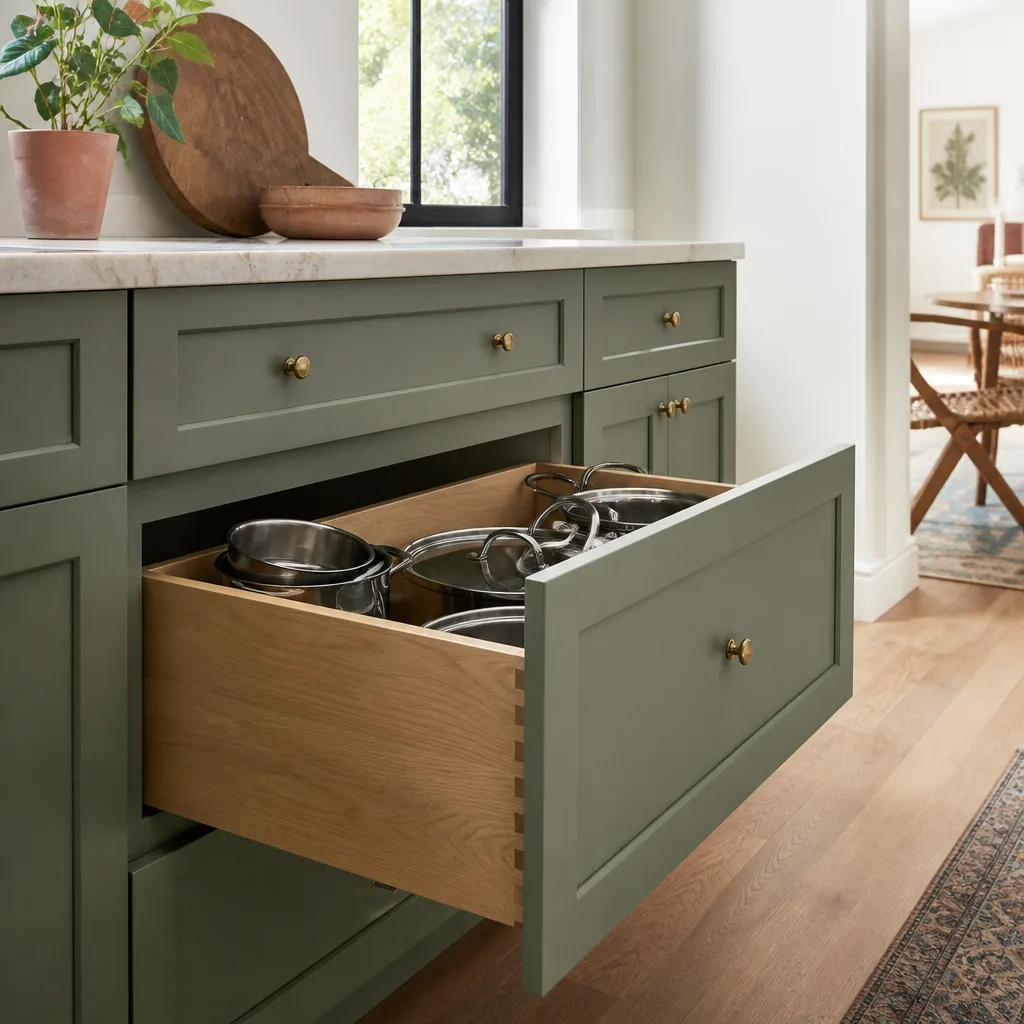
- Cabinet joints: Cabinet doors and face frames are typically made from solid wood, while the boxes are plywood or particleboard. The solid wood moves; the boxes do not. The result is doors that stick, drawers that bind, and hairline cracks in painted finishes at the stile-to-rail joints. We see this most often in kitchens with east-facing windows where morning sun hits humid air inside cabinets.
- Painted drywall: Drywall paper absorbs moisture, which softens the bond between paper and gypsum core. In a room that stays above 65% RH, the paint film can literally peel away in sheets during cleaning. This is different from water staining from a leak. It is a humidity failure.
- Interior door fit: Hollow-core interior doors swell and begin to rub against their frames. Solid-core doors move less but the frames themselves are often pine, which swells. If a door that opened cleanly in May begins to stick in August, the cause is almost always moisture, not foundation movement.
Managing Houston’s summer humidity is primarily about the HVAC system, not dehumidifiers alone. A properly sized air conditioner in Houston removes moisture as a byproduct of cooling. When a system is oversized, it cools the air so quickly that the compressor does not run long enough to dehumidify. The result is a cold, clammy house at 72°F with 65% RH. A standalone dehumidifier helps, but the first thing to check is whether the HVAC drain line is clear and the system is running long cycles rather than short ones. Secondary strategies include ventilating bathrooms to the exterior, not into the attic, and keeping closet doors open during the day so air circulates through enclosed spaces.
If you are planning a kitchen or bathroom remodel in Houston, the summer humidity is a material selection factor, not just a comfort issue. Solid wood cabinet doors, solid wood flooring, and certain painted finishes all respond to the indoor moisture load. Our team at Elmstead Remodeling Houston home discusses this with clients before selections are made, because the material that looks right in a showroom in June behaves differently in a Houston house in August.
The Exterior Work Season: October and November
Houston’s exterior work window opens when daytime highs drop below 88°F and nighttime lows drop below 70°F, usually in early to mid-October. It closes when the first hard freeze arrives, usually in December. This is the stretch when exterior painting, caulking, roof work, and concrete repairs should happen if they could not be done in spring. Budgeting for these projects is easier with a Construction Cost Breakdown: The Houston Homeowner’s Reference for 2026. It is the second of Houston’s two reliable work windows, and it is the one contractors book out fastest.
Why October and November specifically:
- Paint and caulk cure correctly. Latex paint forms a proper film when the surface temperature stays between 50°F and 85°F for at least four hours after application. Houston in July means surface temperatures over 120°F on south-facing walls. October means 70°F to 80°F surfaces.
- Roofing adhesives bond fully. Asphalt shingles seal when the sun heats them, but extreme heat can cause the adhesive strip to activate too quickly, preventing a proper bond. The moderate temperatures of late fall give adhesives time to set correctly.
- The ground is dry enough for foundation and drainage work. Houston’s clay soil shrinks during the summer dry spells and swells after fall rains arrive. October sits in the narrower window when the soil is moist enough to be workable but dry enough that trenches hold shape.
Tasks that belong in the October-November window:
- Exterior painting on the north and east sides of the house. These surfaces get less direct sun, so their paint fails more slowly. They are the logical fall project if the south and west walls were done in spring.
- Roof inspection and minor repair. By October, the summer storm season has exposed any weak spots. This is the time to have ridge caps, flashing, and valleys checked and repaired before winter rain.
- Siding replacement or repair. Fiber cement siding from James Hardie, which is one of the material partners we use on exterior projects, installs well in the fall because the moderate temperatures prevent the expansion gaps from closing after installation.
- Concrete slab repair and sealant. Driveway and walkway cracks that opened during summer drought can be sealed before winter rain enters them and washes out the base.
Homeowners who want exterior work done in October should schedule it in August or early September. The window is short, and every Houston contractor works within it. Waiting until the first cool front arrives means the calendar is already full.
Freeze-Risk Season: December Through February
Houston’s freezes are different from northern freezes, and the damage they cause is different too. A Houston hard freeze is typically 28°F or below for four to six hours, often arriving in the early morning after a cold front. That is not cold enough to freeze ground soil deeply, but it is cold enough to freeze water inside exposed plumbing, because the pipes themselves are not insulated or buried as deeply as they would be in a colder climate. Houston’s building envelope was built for heat and humidity, not sustained cold.
What a brief Houston freeze does to a home:
- PVC plumbing in exterior walls. Pipes running through exterior walls in kitchens and bathrooms are the first to freeze because they lose heat to the outside air on both sides. PVC becomes brittle when cold, so a frozen pipe does not just burst at a fitting; it can crack along the pipe run. When the thaw comes hours later, the leak is inside the wall, not visible at the point of damage.
- Outdoor faucets and hose bibs. Houston homes built before the 2010s often have standard sillcocks, not frost-free hose bibs. A standard sillcock holds water in the pipe segment outside the wall insulation. When that water freezes, the pipe splits behind the faucet, inside the wall. The homeowner sees the leak only when the valve is opened in spring.
- HVAC condensate lines. Condensate drains that run through unconditioned attic space can freeze during a hard event, causing the air conditioner to shut off or the condensate to back up into the unit. During a freeze, heat pumps run in reverse, which means the outdoor unit produces condensate that can freeze into a block on the coil.
Preparation for a Houston freeze is simpler than for a northern home, but it has to be done before the front arrives, not after:
- Insulate or heat-tape exposed pipes in attics, crawl spaces, and exterior walls where they are accessible. This is a permanent fix, not a freeze-night fix.
- Turn off and drain outdoor hose bibs by closing the interior shutoff valve and leaving the exterior faucet open. Remove hoses from the bib, even if the bib is frost-free. A connected hose traps water against the valve.
- Open cabinet doors under kitchen and bathroom sinks on nights when the forecast calls for 28°F or below. This lets warm interior air reach pipes mounted on exterior walls.
- Drip faucets on exterior walls at a slow stream, not a fast drip. The movement of water through the pipe prevents freezing. Drip both hot and cold, because hot water pipes freeze faster than cold ones in some configurations.
- Know where the main water shutoff is and make sure it turns freely. In a freeze event where a pipe does burst, the ability to shut off the water in 30 seconds can be the difference between a puddle and a flooded ceiling.
Houston’s last significant hard freeze events, the February 2021 storm and the December 2022 freeze, both produced the same pattern: PVC pipes in exterior walls failing hours after the temperature dropped, and homeowners discovering the damage only when water began running through ceilings after the thaw. A homeowner who prepares in November avoids the emergency call in February. For those who do not, the recovery work is the same as any water damage: dry out, cut out, replace. It is always more expensive than the preparation.
Recovery Season: Late February Through Early March
Recovery season in Houston is the few weeks between the last hard freeze and the opening of the spring repair window. It is a short period, usually late February through early March, and it is the time to assess what winter did and schedule the spring work. Winter in Houston is mild compared to northern states, but it still imposes freeze-thaw cycles on concrete, caulk joints, and wood trim that the summer heat never does.
What to look for during recovery season:
- Exterior caulk failure at trim joints and window perimeters. Caulk contracts in cold weather, and if it was already near the end of its life, the freeze cycle will pull it away from the surface. Cracks that were small in November may be open by March.
- Concrete spalling and new cracks. Water that entered small concrete cracks before the freeze expands when it turns to ice, widening those cracks. Walk the driveway, walkways, and patio and mark any new damage with spray paint so it can be addressed in the spring window.
- Fence post movement. Houston’s clay soil holds water differently in winter. Posts that were solid in October may have shifted during winter rain cycles. Check fence lines for leaning or gaps at the base.
- Roof granule loss at downspout outlets. After winter rain, asphalt shingles shed some granules. If the downspout splash blocks show an accumulation of granules, the roof surface has begun to degrade and should be inspected before summer storms.
Recovery season is not a time for major work. The temperatures are still too cold for paint and caulk to cure reliably, and the ground is usually saturated. It is a time for assessment and scheduling. Homeowners who do this assessment in late February have their pick of contractor availability for the spring window. Those who wait until the first 90°F day in May are competing for the same slots with everyone else, and they are asking materials to perform in conditions they were never designed for.
Common Mistakes to Avoid
- Treating Houston like a northern climate. Northern maintenance schedules emphasize winterizing in October and March. Houston’s risk calendar is inverted: the summer is the destructive season, and the mild winter is when exterior work should already have been completed. Following a generic four-season checklist means doing the right tasks in the wrong months.
- Neglecting the spring caulk check. Caulk is the cheapest material on a Houston house and the most consequential. A failed caulk joint lets water into the wall cavity for months before the damage is visible. In our experience, most Houston rot repairs trace back to a caulk failure that was visible in March and ignored until September.
- Running a portable dehumidifier but never checking the HVAC drain line. A dehumidifier removes a few pints per day. An air conditioner in Houston removes several gallons. If the condensate drain is clogged and the system is discharging into the attic or the walls, the dehumidifier is working against a much larger water source.
- Ignoring garage door wind ratings. Most Houston homeowners think of the garage door as a convenience feature. In a hurricane, it is a structural component. A door that fails under wind pressure lets the storm inside the house, and the roof follows. This is the single most overlooked item on pre-hurricane checklists.
- Waiting until a freeze is forecast to insulate pipes. Houston hardware stores sell out of pipe insulation and heat tape the day before a freeze. The time to insulate exterior-wall plumbing is October, when the supplies are in stock and the weather is pleasant enough to work in the attic.
- Painting the exterior in June or July. Latex paint applied to a 120°F surface flashes, meaning the water evaporates before the film forms. The result looks fine for a few weeks, then blisters and peels by September. Houston’s only reliable exterior paint windows are March to April and October to November.
When to Call a Professional
Some seasonal maintenance tasks are homeowner work: cleaning gutters, checking caulk, opening cabinet doors before a freeze. Others need a professional, and the line is usually where water intrusion or structural movement is involved. If you see water staining on a ceiling or wall that appeared after a rain or freeze, do not paint over it. The source has to be found and fixed first. If a foundation crack widens or a door suddenly stops latching, that is a sign of soil movement that needs evaluation before it becomes a structural issue. If a roof has lost ridge cap pieces or shows granule loss at downspouts, a full inspection is warranted before the next storm season. And if a freeze event caused a pipe failure you cannot see, a plumber’s assessment is worth the visit. Elmstead Remodeling Houston offers free estimates in Houston for remodeling and repair work. Call (254) 272-5240 to schedule a walkthrough.
Frequently Asked Questions
Houston’s maintenance calendar is driven by heat, humidity, and brief freezes rather than long winters. The most damaging season is summer, when sustained indoor humidity above 60% and UV exposure degrade paint, caulk, wood, and flooring over a single season. Exterior work belongs in the two mild windows: March to April and October to November.
The highest-value task is a pre-hurricane exterior audit completed by mid-May. It catches ridge cap failure, soffit vent damage, caulk gaps, and garage door wind rating issues before the August to September storm peak, when those small failures become water intrusion and structural damage.
Exterior painting in Houston should happen in March to April or October to November, when surface temperatures stay below 85°F and humidity is low enough for paint to cure. Painting in summer causes the paint to flash and fail within a season.
Sustained indoor relative humidity above 60% causes solid wood flooring to cup, cabinet doors to stick, painted drywall to peel, and interior doors to swell against their frames. The damage accumulates over a single summer and is often misdiagnosed as foundation movement or water leakage.
Insulate exposed pipes in attics and crawl spaces, drain and shut off outdoor hose bibs, open cabinet doors under sinks on exterior walls, drip faucets during the freeze, and know where the main water shutoff is. Preparation in October and November prevents the burst-pipe emergency that arrives with every Houston hard freeze.
Yes. Elmstead Remodeling Houston is a Cedarwell company and provides general contracting, bathroom remodeling, kitchen remodeling, and whole-home remodeling. Browse our more guides & resources for additional homeowner help. That includes the repair work that seasonal maintenance uncovers: rotted trim, water-damaged drywall, failed caulk, and exterior material replacement. Every project includes a written price before work starts and the 365-Day Done Right Promise.
The Bottom Line

Houston homes fail on Houston’s schedule, not a calendar’s. The summer heat and humidity do the most damage, the hurricane window concentrates the risk from May to September, and the brief freezes punish any plumbing left exposed. The homeowners who avoid the worst repairs are the ones who treat March and April as the spring repair window, May and June as storm prep season, October and November as the exterior work season, and December through February as freeze-risk season. Organizing maintenance around that pattern, and scheduling the work early, is the difference between a house that ages gracefully and a house that surprises its owners every September. If you’re planning seasonal repairs or a larger remodel, contact General Contractor in Houston at Elmstead Remodeling Houston. We also provide Bathroom Remodeling in Houston and Kitchen Remodeling in Houston, and we’re glad to walk any Houston homeowner through what their house needs this season. Call (254) 272-5240 for a free estimate.
Written by Graham Stein, Owner at Elmstead Remodeling Houston, serving Houston since 2005.
See the difference
 Before
 After
After Before
 After
After Before
 After
After

