
Free written scope consultation - allowances, timeline, and change-order rules on paper before a single trade is scheduled
Cambridge Pavers Home Additions & ADU: The Houston Owner’s Guide
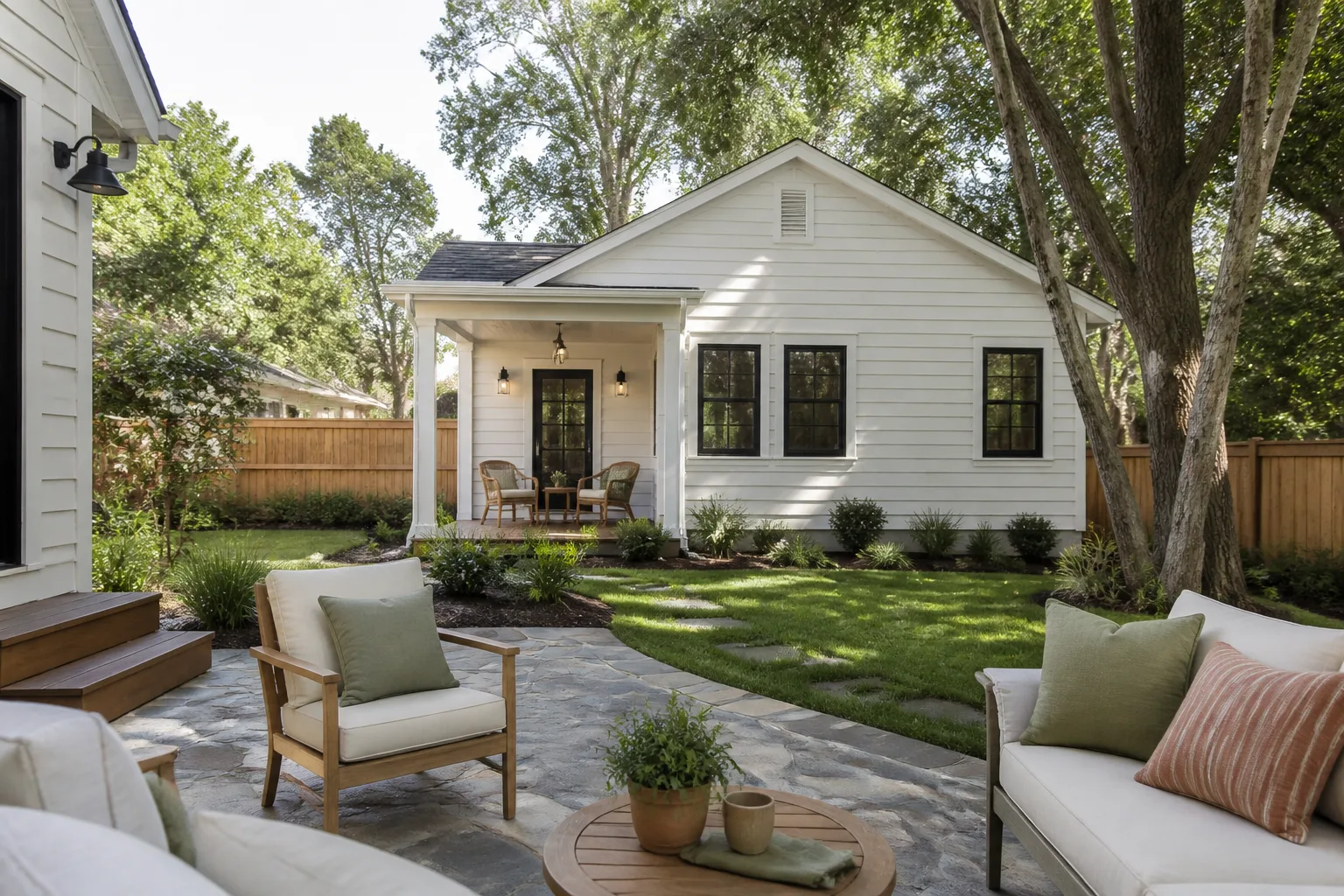
If you’re planning a home addition or ADU in Houston with Cambridge Pavers as part of the exterior hardscape, you’re looking at a full project range of $45,000 to $130,000, and we can walk you through every line item before a single tool comes out of the truck. The most common way Houston owners reach out to us is mid-planning: they’ve chosen Cambridge Pavers for the patio, walkway, or driveway apron that will tie the addition to the existing structure, and they want to know whether the paver layout, drainage, and base prep will actually hold up under Houston’s clay soil and rain patterns. The good news is that Cambridge Pavingstones with ArmorTec are among the more predictable materials we work with in this market, provided the sub-base is built correctly and the pavers are ordered with the right joint sand and edge restraint for our climate.
What usually triggers the call is not a failed paver itself, but a problem at the transition: the addition’s foundation meeting the paver surface, a slope that isn’t carrying water away, or an edge restraint that has started to bow after two or three wet seasons. We’re an independent remodeling contractor, not a Cambridge Pavers dealer or affiliate, but we install and integrate their paver lines on home additions and ADUs across Houston regularly enough that we keep a working knowledge of which products perform where.
Key Takeaways:
– Home additions in Houston with Cambridge Pavers hardscape run $45,000 – $130,000 total.
– The paver portion of the job is usually 8 – 15% of the total budget, depending on square footage and pattern.
– Houston’s expansive clay soil means the paver base prep matters as much as the paver itself.
– Written price before any work starts, every time.
– Live person answers the phone at (254) 272-5240, 24/7.
Which Cambridge Pavers Models This Applies To
Cambridge Pavers makes three primary product lines we work with on home additions and ADUs in Houston: the Ledgestone series (tumbled, rustic edges), the Roundtable collection (a cobblestone look with a wider color range), and the Sherwood line (smooth, modular, more contemporary). Within each, pavers come in multiple thicknesses, typically 60mm for pedestrian areas and 80mm for driveways or any surface that will see vehicle traffic. The compatibility gotcha we see often: a homeowner buys 60mm pavers for the patio because the color matched, then realizes the driveway apron to the new ADU needs 80mm to handle a car. That’s a costly reorder if it’s caught late.
To identify what’s on an existing paver surface, look at the underside of a lifted paver or check the pallet tag from the original delivery. Cambridge stamps their name and the series on the side of most units. If you’re matching an existing patio for an addition, take photos and measurements (length × width × thickness) and bring them to the conversation. We’ll verify the series, but Cambridge colors can shift slightly between production runs, so we recommend ordering all pavers for a project at once rather than in phases. Aftermarket alternatives from Unilock, Belgard, and Techo-Bloc exist and can sometimes be spec’d in for cost savings, but color matching to existing Cambridge work is rarely clean. For new construction or full additions, we quote Cambridge OEM pavers unless the homeowner asks otherwise.
Styles & brands we work with







Signs Your Cambridge Pavers Home Additions & ADU Is Failing
– Sinking or lipping pavers near the addition’s foundation line. This almost always traces back to base prep: loose fill, insufficient compaction, or a missing geotextile layer. Houston’s clay soil expands and contracts with moisture, and a paver that looked perfect in October can sit a half-inch low by May. The fix is lifting, recompacting, and sometimes adding base material, not just sweeping more sand on top.
– Joint sand washing out after every heavy rain. If the gaps between pavers go from filled to hollow within two or three storms, the edge restraint has probably failed or was never installed properly. Water gets under the pavers, carries sand out, and the surface starts to drift. It’s the single most preventable failure we see on Houston additions.
– White, chalky efflorescence spreading across the surface. This is a cosmetic issue, not structural, and it’s common on Cambridge pavers in humid climates. Efflorescence happens when natural salts in the concrete rise to the surface as moisture evaporates. It can be cleaned, but if it returns repeatedly, the paver bed may be holding water it shouldn’t.
– A trip hazard forming at the threshold where the paver patio meets the addition’s door. This is usually a settling issue at the most heavily trafficked point on the surface. Houston’s rain patterns mean water pools exactly where people walk, and the sub-base fails there first.
– Weeds or grass pushing up through the joints from below. A sign the base was too shallow or the wrong type for Houston’s soil. Weeds need organic material to grow, and a properly built paver base has none.
See the difference
 Before
 After
After Before
 After
After Before
 After
AfterReplacement Cost & What’s Included
The full home addition or ADU project in Houston runs $45,000 – $130,000, and the Cambridge Pavers portion typically lands between $3,500 and $11,000 depending on square footage, pattern choice, and whether it’s pedestrian-only or needs to carry a vehicle. Here’s how the paver-specific work breaks down:
| Scope | Houston Price Range |
|—|—|
| Paver patio (pedestrian, 200 – 400 sq ft) | $3,500 – $11,000 |
| Paver driveway or full driveway apron | $7,000 – $18,000 |
| Paver walkway connecting addition to existing home | $2,500 – $6,500 |
| Edge restraint replacement (existing paver surface) | $800 – $2,500 |
| Full removal and reinstallation of failed paver base | $5,000 – $14,000 |
Every quote includes the written price before work starts, the base prep (excavation, compaction, geotextile where needed), the Cambridge pavers themselves, joint sand, edge restraint, and the clean-up. The Cedarwell Care Promise applies for the whole project: shoe covers and drop cloths inside the house, quiet tools during family rest hours where possible, and pet-safe product choices where available. A photo of the clean-up before the crew leaves is part of every job.
DIY or Call Us?
Pavers themselves are not a dangerous material to handle, and a homeowner can absolutely check a few things before calling: measure the thickness of an existing paver, note whether the joints are holding sand, and watch where water pools after a rain. What goes wrong with DIY on this front is not injury, it’s scope. A paver surface that is failing usually has a base problem, not a paver problem, and fixing the base requires excavation equipment, compaction, and a real understanding of drainage grading. Houston clay does not forgive shortcuts. If the pavers are sinking, lipping, or washing out, that’s a base rebuild, not a weekend project.
That said, if you want to reset a single cracked paver on a small section and the base is solid, it’s a reasonable afternoon job. Anything beyond that, we’d rather talk first. Call (254) 272-5240 and we’ll tell you honestly whether you need us or just some joint sand and a rubber mallet.
*”A written price and a covered floor before any work begins – that is where the trust starts.”*
FAQs
How long do Cambridge Pavers last on a Houston home addition?
Cambridge Pavingstones with ArmorTec are built to last 30 to 50 years as a surface material, but the base underneath them in Houston typically needs attention at the 15 to 20 year mark because of our expansive clay. The paver itself rarely fails, the base settles, and that is what drives most replacement work we do.
Can a failing paver base be repaired instead of fully replaced?
Yes, often it can. If the problem is isolated to one section (a low corner, a threshold area), we can lift that area, recompact the base, add material, and reset the pavers without touching the rest of the surface. Full replacement is reserved for cases where the entire base was never built correctly. Call (254) 272-5240 and we’ll look at photos or come out for an assessment.
How long does the paver portion of a home addition take in Houston?
For a typical patio of 300 square feet, plan on 3 to 5 working days from excavation to final joint sand. Driveway aprons that need to handle vehicle weight add 1 to 2 days. We schedule around the bigger project timeline for additions and ADUs so the hardscape lands when the structure is ready. Live person answers the phone 24/7 if you need to check a date.
Do you stock Cambridge Pavers on the truck, or do we order them?
We order Cambridge Pavers per project from Houston-area distributors, which usually means a 1 to 2 week lead time once the color and series are confirmed. We do keep joint sand, edge restraint, and base material stocked. For matching existing work, we strongly recommend ordering the full project quantity at once so production-run color variation isn’t a problem.
Will the price change once the paver work starts?
No. The written price we give before any work starts is the price you pay. If we find hidden problems during base prep (old tree roots, buried utility lines, unexpected clay pockets), we stop, walk you through what’s there, and agree on any change in writing before we touch it. No surprises at the end.
Written by Graham Stein, Owner, Elmstead Remodeling Houston at Elmstead Remodeling Houston, serving Houston and nearby areas.


